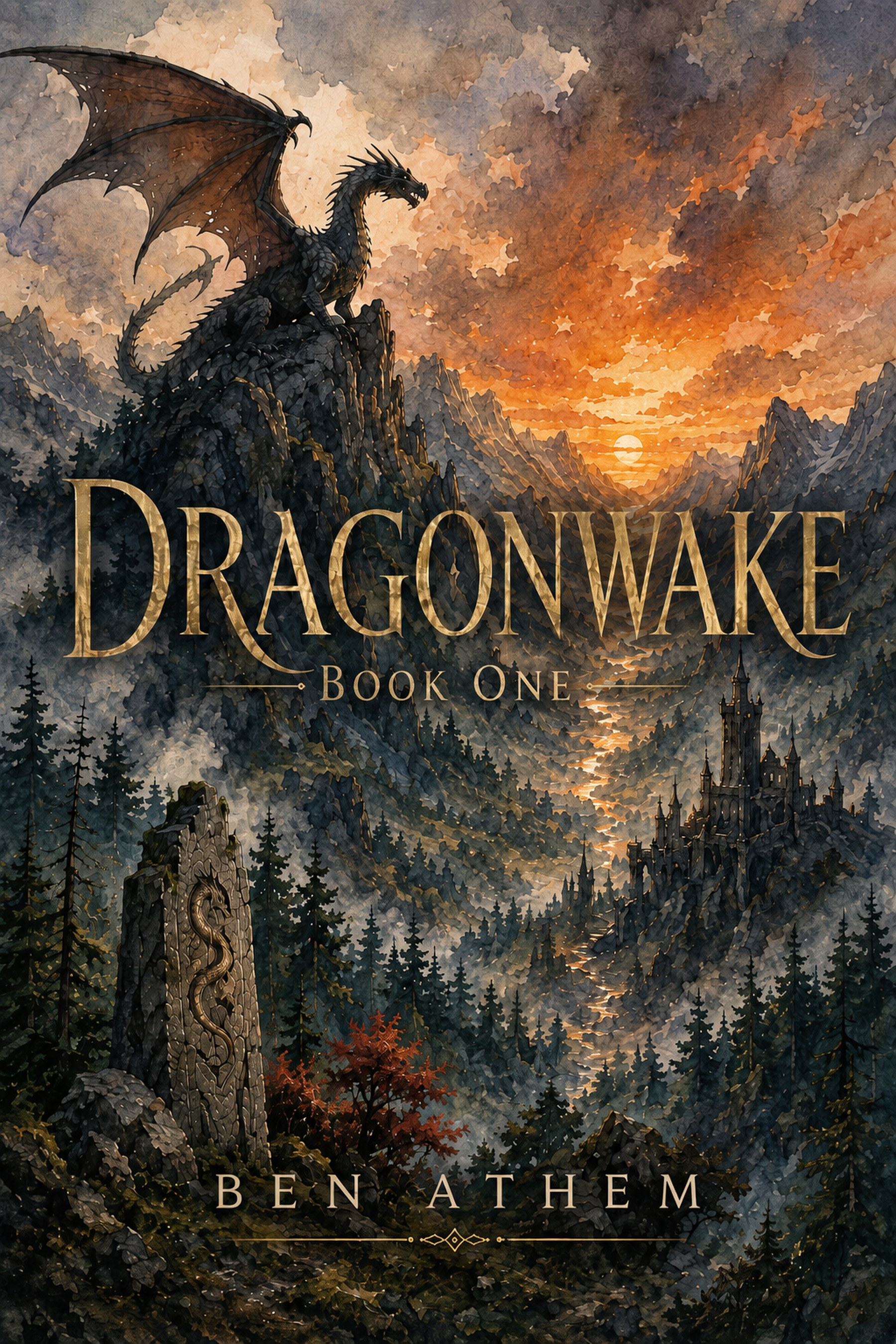
Dragonwake Book One
PROLOGUE
The first thing Elara learned about dragons was that they could scream. The sound rolled down from the Greyspines and shook flour from the rafters. The cup in her hand slipped and struck the table, spilling water across the wood. Her mother stopped kneading the bread. For one breath, neither of them moved. Then the warning bell began to ring. It was not a sound Elara had heard before. The old iron bell beside the meeting hall was used for fires and floods, but never with such violence. Whoever held the rope was pulling hard enough to make every strike crack. Her mother wiped her hands on her apron and crossed the room. She opened the door only as far as the latch allowed. People were running toward the northern fields. Others were running away.
“Mama?” Her mother closed the door and slid the wooden bar into place. “Put your shoes on.” “But—” “Now, Elara.” Elara obeyed. Her fingers fumbled with the buckles while another scream broke over the village. This one ended in a ragged sound that was almost a cough. Something struck the earth outside. The floor jumped beneath her feet. Her mother reached her just as the front window shattered inward. Heat rushed through the room. Not flame. Not yet. Only air made suddenly dry and breathless. Through the broken window, Elara saw a wing. It filled the lane from one house to the next, its dark membrane torn in three places. The hooked tips dragged through thatch and sent roof tiles clattering to the ground. Beyond it, something vast struggled to rise. A dragon.
He was larger than their house. His scales might once have been red, but soot and blood had darkened them almost to black. One foreleg folded beneath him when he tried to stand. A broken spear jutted from behind his shoulder, buried deep enough that only half the shaft remained. There were arrows in his neck and another beneath his jaw. The blood around those wounds had already dried. He had not received them here. Men gathered at the far end of the lane with bows, wood axes, and grain forks. Elara recognized the blacksmith. The miller. Old Tomas, who gave her sugared plums when her father was not looking. They looked nothing like themselves. “Stay back!” someone shouted. The dragon turned toward the voice. His golden eyes were wide enough for Elara to see the white around them. An arrow struck the soft skin beside his mouth. He recoiled.
Fire came with the cry. It did not pour from him in one clean stream. It burst out in a broken rush, sweeping across the meeting hall and the house beside it. Thatch caught at once. A man fell in the road, beating at his burning sleeve. Everyone began shouting. The dragon thrashed against the buildings hemming him in. His tail went through a stable wall. Horses screamed. Another volley of arrows struck his wings, and he answered with fire because pain was the only language anyone had left him. Elara’s mother pulled her away from the window. “The root cellar,” she said. “Keep hold of me.” They went through the back door into smoke. The yard had changed. Cinders drifted through it like red snow. Their apple tree burned along one side, its leaves curling in the heat. Elara covered her mouth with both hands, but smoke found its way between her fingers. Her mother caught her wrist and ran. The root cellar lay beyond the shed, built into the rise at the back of their garden. They were halfway there when the dragon’s wing struck the roof. The world came apart in wood and stone. Her mother shoved her forward. Elara hit the ground beside the cellar doors. Something heavy landed across her legs. For a moment there was no pain, only pressure and a strange quiet inside her head. Then she heard her mother breathing.
Once. Again. Not again. “Mama?”
Elara twisted beneath the broken timber. Pain tore through her ankle. Behind her, most of the shed had collapsed into the yard. Her mother lay beneath it. Only one hand remained visible. Elara reached for it, though she was too far away. “Mama.” The dragon screamed again. This time, another voice answered. A shadow passed over the smoke. Wind flattened the burning grass as a second dragon descended into the yard. She was pale where the first dragon was dark, her slate-colored scales silvered along the edges. Age had not yet bowed her, but scars crossed one wing and ran down the side of her neck. She landed between the wounded dragon and the men gathering in the lane. The sounds she made were too deep for Elara to understand. They passed through the ground and into her bones. The wounded dragon went still. The pale dragon lowered her head to his. For one brief moment, the village disappeared around them. There was only the touch of her brow against his and a low sound that did not need translating. Then she turned toward Elara. Elara tried to pull herself free. The timber pressed harder against her legs. The dragon came closer. Every story Elara had ever heard told her to scream. She could not find enough breath. One enormous golden eye lowered until it was level with her. The dragon looked at the hand protruding from the wreckage. Then at Elara. “Alive?” The word was rough, shaped by a mouth not made for human speech. Elara stared. The dragon waited. Elara shook her head. Something changed in that golden eye. Not hunger. Not anger. Grief.
The dragon placed one claw beneath the beam pinning Elara. The talon was longer than Elara’s arm, but it moved with impossible care. “Do not move.” She lifted. Elara dragged herself free. The dragon curved one forefoot around her—not touching, only sheltering—and carried her away from the burning shed. Men poured into the garden. Elara’s father was among them. His face changed when he saw the wreckage. Then he saw Elara beneath the dragon’s claws, and grief became something else. He raised his spear. “No!” Elara tried to stand. Her ankle folded, and she fell against the dragon’s foot. “She helped me.” Her father did not seem to hear. The pale dragon could have killed him. Elara understood that even then. One sweep of her claws would have opened him from shoulder to hip. Instead, she stepped back. She left Elara in the grass and turned toward the wounded dragon. He had reached the northern road. One wing dragged behind him. Men followed at a distance, loosing arrows whenever they found a clear path between the houses. The pale dragon looked at Elara once more. Then she followed him into the smoke. Elara’s father gathered her into his arms. He held her so tightly it hurt. She let him. Over his shoulder, she watched the pale dragon disappear. They found the wounded dragon before dawn. He had collapsed in a ravine less than two miles from the village. The men said he attacked when they approached. They said they had been given no choice. They said many things in the days that followed, and with every telling, the dragon’s old wounds vanished from the story.
By the time the dead were buried, he had arrived from a clear sky with fire already in his mouth. The second dragon had come to help him destroy what remained. Elara told them otherwise. “She saved me,” she said. The adults exchanged looks above her head. The healer said smoke could make the mind build strange memories. Her aunt said terror sometimes made kindness out of monsters. Her father said nothing at all. On the seventh day, he took Elara to the blacksmith’s forge. He had not shaved since her mother died. His eyes looked bruised, and the hand holding hers trembled whenever he thought she was not paying attention. On the worktable lay a dragon’s fang. It was nearly as long as Elara’s forearm, white at the tip and dark with blood at the root. “It pierced their hide,” the blacksmith said quietly. “When the spearheads couldn’t.” Elara’s father stared at the fang. “Then make me a weapon from it.” Elara pulled at his hand. “Papa.” He looked down at her, and for a moment she saw the father who had carried her home from the river when she cut her foot. The father who tucked blankets beneath her chin and always saved the crisp edge of the honey cake for her. Then he looked back at the fang. “No dragon will do this to us again.”
That evening, Elara found the pale dragon waiting beyond the burned apple tree. She wore the shape of a woman now, wrapped in a gray cloak. Silver threaded her dark hair. The same golden eyes watched Elara approach. Elara stopped several paces away. “What was his name?” she asked. The woman’s face tightened. “Korath.” “He killed my mama.” “Yes.” Elara had expected an excuse. The simple answer hurt more. “My father killed him.” “Yes.” For a while, neither of them spoke. Behind Elara, hammers rang from the forge. The blacksmith had begun shaping the fitting that would hold the fang. “I am Senna,” the woman said at last. Elara looked at the stranger who had saved her, and at the grief she recognized because it lived inside her too. She did not forgive her. Senna did not ask her to. Elara sat beneath the burned apple tree. After a moment, Senna sat beside her. Behind them, the first weapon of the Long Hunt was being made.